
Tariffs With a Discount for Signing: Washington Just Turned Trade Into a Risk-Based Price
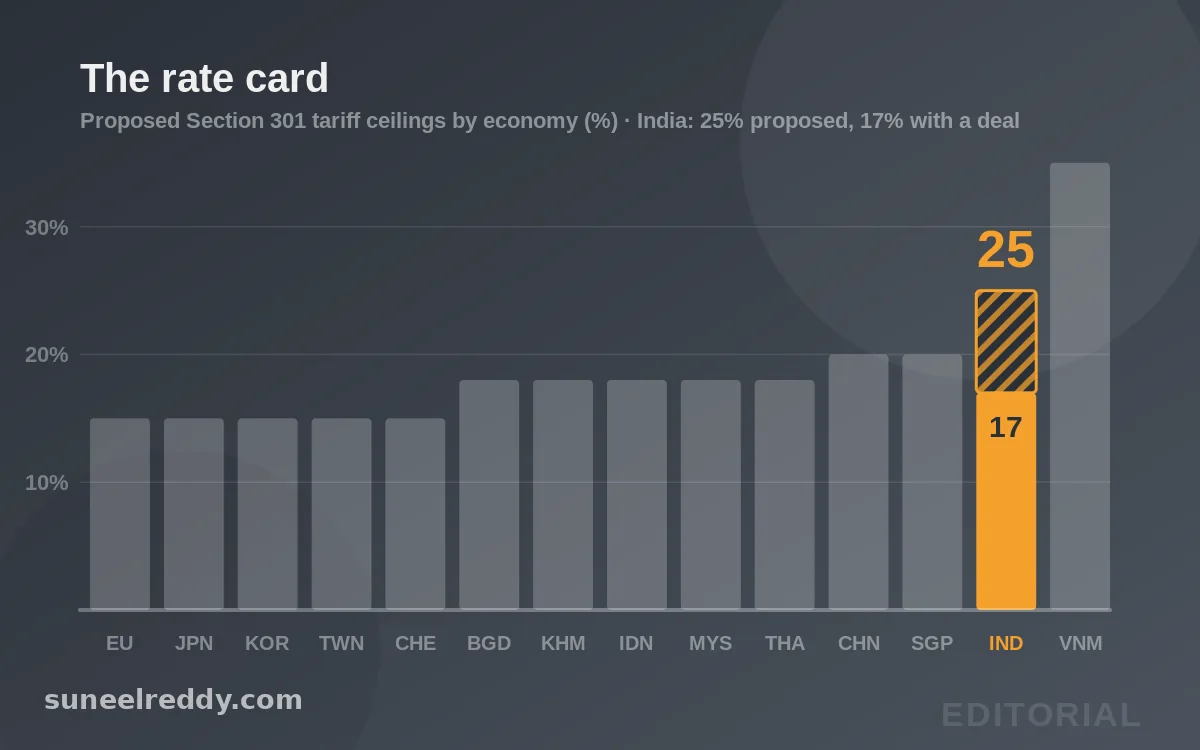
Washington published a price list this week. Not a tariff wall, a price list: a sticker rate, a discount for signing, and a penalty for walking away. If you have spent any time around credit systems, you will recognise the shape immediately.
Here is what happened. On November 25, the US Trade Representative announced findings in its Section 301 investigations into “structural excess capacity” in manufacturing, and proposed tariffs on 14 of the 16 economies it examined; Mexico and Norway got no determination for now. The proposed rates run from up to 15% for the EU, Japan, Korea, Taiwan and Switzerland, to 18% for much of Southeast Asia and Bangladesh, up to 20% for China and Singapore, up to 25% for India and up to 35% for Vietnam. India's rate could fall to 17% if a binding trade agreement is concluded, Singapore's to 10% and Vietnam's to 20%, with higher fallback rates if talks fail. Nothing is in force yet: comments are due January 5, and hearings are set for January 25. The route matters too. These investigations were launched in March, after the Supreme Court struck down the use of IEEPA for tariffs in February, so Section 301 has become the main vehicle.
This is risk-based pricing, applied to countries. In credit, the logic is always the same: a base rate, adjustments for observed behaviour, a better tier for borrowers who sign covenants, and a worse one for those who don't. USTR's notice reads exactly like that rate card. The excess-capacity finding is the risk score, the negotiated deal is the covenant, and the gap between 25% and 17% is the price of not having signed.
You can disagree with the scoring model, and many economists reasonably will. They will argue that labelling a partner's factories “unreasonable” is a policy choice dressed up as a finding, and that tariffs are largely paid by American buyers. That debate is legitimate. But for anyone running a business across the US–India corridor, the more useful question is not whether the model is fair. It is how to operate while it is live.
A tariff is a tax that both sides pay. On the American side, the duty is collected from the US importer at the border, in dollars. That importer either absorbs it in margin or passes it on, and research on the 2018–19 tariffs found that most of the cost landed on US importers and consumers rather than on foreign suppliers. American buyers also lose options: if India at 25% is no longer a cheap alternative to Southeast Asia, the “China plus one” playbook gets more expensive for them too. On the Indian side, the cost shows up as lost orders and thinner margins, especially in labour-intensive sectors. And here the relative rate matters more than the absolute one. At 25%, India sits seven points above Indonesia, Thailand and Malaysia at 18%. At 17%, it sits just below them. That swing decides where a US buyer places next year's order.
The exchange rate is where the bill gets split. Fewer export dollars coming in means pressure on the rupee to weaken, and a weaker rupee hands some of the tariff back to exporters: every point of depreciation makes Indian goods a point cheaper in dollars. But it also makes oil and every other import dearer, which feeds inflation at home. For now, other forces are bigger. The rupee hit its strongest level since March this week, near 92.2 to the dollar, helped by lower oil prices and a return of foreign equity buying, then slipped back to around 93.1 by Thursday as Brent climbed above $96. My read: the tariff will not set the rupee on its own, but a 25% outcome adds a lasting drag that a 17% deal removes. Exporters should not count on depreciation as a free hedge. The RBI has been leaning against sharp moves, including covering the dollar needs of state-run oil companies directly since October, so the currency is more likely to drift than to rescue anyone.
The eight points are a probability, not a number. An Indian exporter quoting a US buyer for delivery next spring doesn't know whether the duty will be 17% or 25%. That uncertainty is where the real damage happens, and it lands hardest on MSMEs. A large exporter can absorb a quarter of margin compression. A 40-person components or textiles firm feels it as stretched receivables, buyers asking for price holds, and working-capital lines under review by lenders who can't price the outcome either. In building an MSME credit-rating platform, this is the moment I worry about most: when a sound business looks riskier on paper than it is, because the scorecard sees the shock but not the plan.
So my stance is simple. India should close its deal, and Indian MSMEs should not wait for it. Model both tiers now. Put tariff-scenario clauses into US contracts. Talk to your banker before the January hearings, not after a final notice. Hedge a sensible share of US receivables instead of betting on the rupee. Diversify one customer and one market at a time. And lenders and rating agencies should give credit to firms that show this work, rather than marking down an entire sector on the headline rate.
Trade has become a priced relationship. The companies that treat it that way first will set the terms for everyone else.
If you export to the US, which tier are you planning for, 17 or 25, and what would change your mind?