
Same Company, Two Buyers: What the Share Price Assumes, and Where a Buyout's 20% Comes From
Two investors look at the same listed company.
One is buying a few hundred shares in a brokerage account. The other is a buyout fund that wants to own the whole thing, pay a premium to get it, and borrow most of the money.
They are reading identical financial statements. They need to answer completely different questions — and most valuation tools give both of them the same answer.
Open the public company valuation workbench — four illustrative companies, both buyers, everything live.
The retail investor: stop asking what it is worth
A forward DCF asks you to forecast ten years of revenue, margins and reinvestment for a business you only see from the outside, then hands back a precise number built on imprecise guesses.
Turn it around. The price is already known. Solve for the growth that justifies it, and the question becomes one you can actually reason about: is it plausible that this company grows at that rate for five years?
That judgement gets much better with a base rate. Michael Mauboussin and Dan Callahan's May 2026 update gives five-year nominal sales growth for US public companies with $2–5bn of starting sales, 1950 to 2025: mean 6.9%, standard deviation 11.1%, 19,264 observations. The workbench solves for exactly a five-year growth phase so the comparison is like for like.
| Company | Market multiple | Growth the price assumes | Peers that historically beat it |
|---|---|---|---|
| Consumer staples | 16.4× EBITDA | 6.4% | 52% |
| Cyclical industrial | 10.0× | 8.8% | 43% |
| Profitable software | 14.3× | 13.3% | 28% |
| Mid-cap services | 8.3× | 0.9% | 70% |
The “expensive” staples name assumes middling growth. The “cheap” industrial assumes more than the staples does. Multiples on their own were telling you the wrong story in both directions.
One accounting choice moves the answer more than any forecast
On the software company, stock-based compensation runs at 9% of revenue. Count it as a cost, and the price implies 13.3% a year of growth. Add it back, as many adjusted metrics do, and the implied growth falls to 6.2%.
A seven-point swing from a single accounting choice — larger than any reasonable change to the growth or margin assumptions. Stock comp is paid instead of salary. The dilution is real even though no cash leaves. A valuation that ignores it is valuing a company whose employees work for free.
The buyout fund: where does the 20% actually come from?
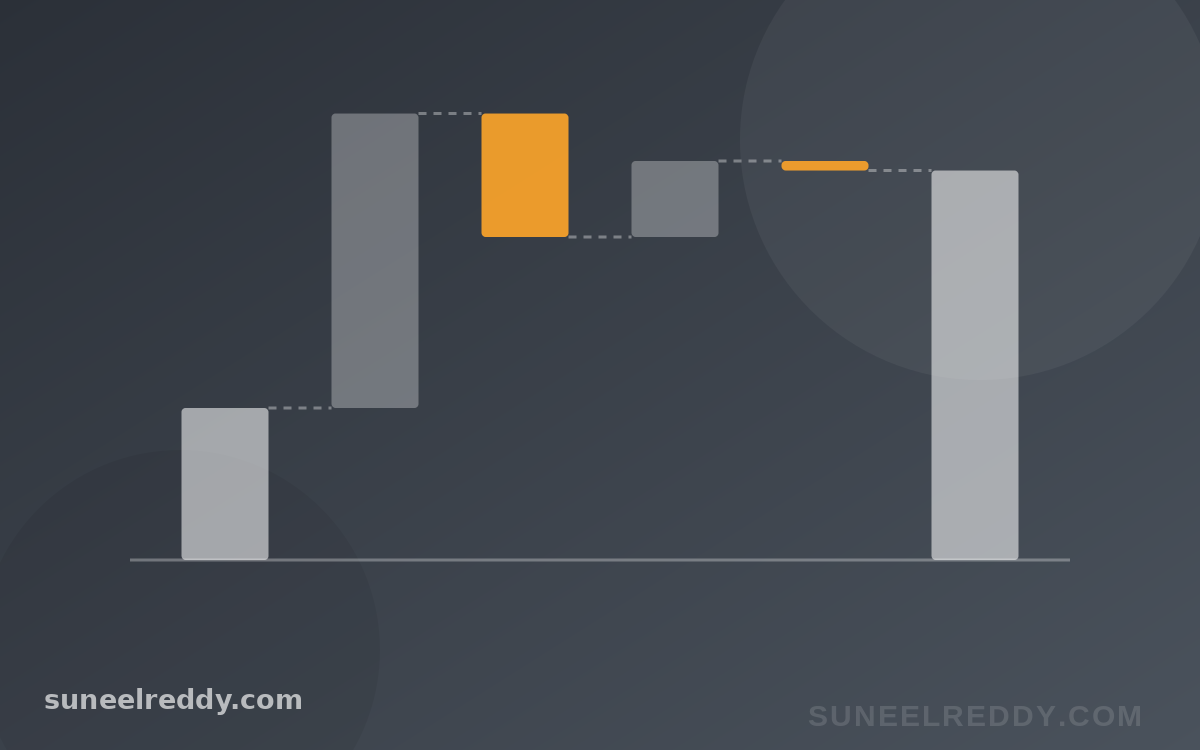
A leveraged buyout makes money three ways: EBITDA grows, the exit multiple differs from the entry multiple, and cash flow pays down debt. The workbench splits the fund's gain into exactly those pieces, and the pieces sum to the total.
On the mid-cap services company — 30% premium, 5.5× debt, a plan that adds 120 basis points of margin a year:
- EBITDA growth adds $2.80bn of equity value
- The multiple subtracts $1.20bn
- Debt paydown adds $835m
- Fees cost $61m
IRR: 20.8%.
The negative multiple line is the part most models hide. The fund paid 30% over market, then exits at the multiple the market paid before the bid. The premium has to be earned back from operations, and here it eats about 43% of everything EBITDA growth creates.
Change one input — let the exit multiple equal the entry multiple, assuming the next buyer pays the same control premium — and the IRR jumps from 20.8% to 27.4%. That single assumption is frequently the difference between a deal that works on paper and one that works.
Which company is actually a buyout candidate
The workbench solves for the highest premium each fund can pay and still earn 20%:
- Staples at 16× EBITDA: the price would have to fall about 32% first. The multiple is too high for leverage to help.
- Industrial: the price would have to fall 17%.
- Software: up to a 20% premium, and only with a take-private cost programme adding 250 basis points of margin a year.
- Services: up to 32%. Cheap, under-levered, improvable — exactly what a sponsor screens for.
That ceiling links the two buyers. When it sits above the market price, a retail holder owns an option on a bid as well as the business. When it sits below, nobody is coming to rescue the share price. Neither is a reason to buy. Both are worth knowing.
What it leaves out
Annual periods, one debt tranche, no revolver or minimum cash, no dividend recaps, no management equity, no refinancing during the hold. The companies are illustrative composites, not real tickers, and the base-rate percentile uses a normal approximation the authors themselves caution the distribution doesn't fit perfectly. Not investment advice.
This is part two. Part one covers private companies — stage-appropriate methods, the cap table, and what a liquidation preference does to the founders at exit.