
B2B Credit, Part I — The Grant Decision: Who Gets COD, Who Gets Net 30, and Who Earns 90 Days
Part I of a three-part series on B2B trade credit. Part I covers the grant decision — policy, scoring, limits and terms. [Part II](#/post/b2b-credit-part2-monitoring) covers monitoring the book. [Part III](#/post/b2b-credit-part3-collections) covers collections and the cash conversion cycle. Illustrative frameworks, not credit advice.
Every time you ship goods before being paid, you have made a loan. No credit committee met, no facility letter was signed, and the interest rate is zero — but the risk is identical to a bank's, and the amount outstanding across the economy dwarfs most formal lending books. Trade credit is the largest unsecured credit market in the world, and the majority of it is extended by people whose incentive is to close the sale.
That tension — sales wants volume, finance wants cash — is the whole subject. A credit policy is simply the written peace treaty between them.
What terms actually are: price, expressed in days
The first mental shift: payment terms are not an administrative detail, they are a pricing decision. Extending Net 60 instead of Net 30 on a ₹1 crore account, at a 12% cost of capital, hands the buyer roughly ₹1 lakh of free financing per turn. If your net margin is 8%, thirty extra days of terms consumes an eighth of the profit on that order — before a single rupee goes bad.
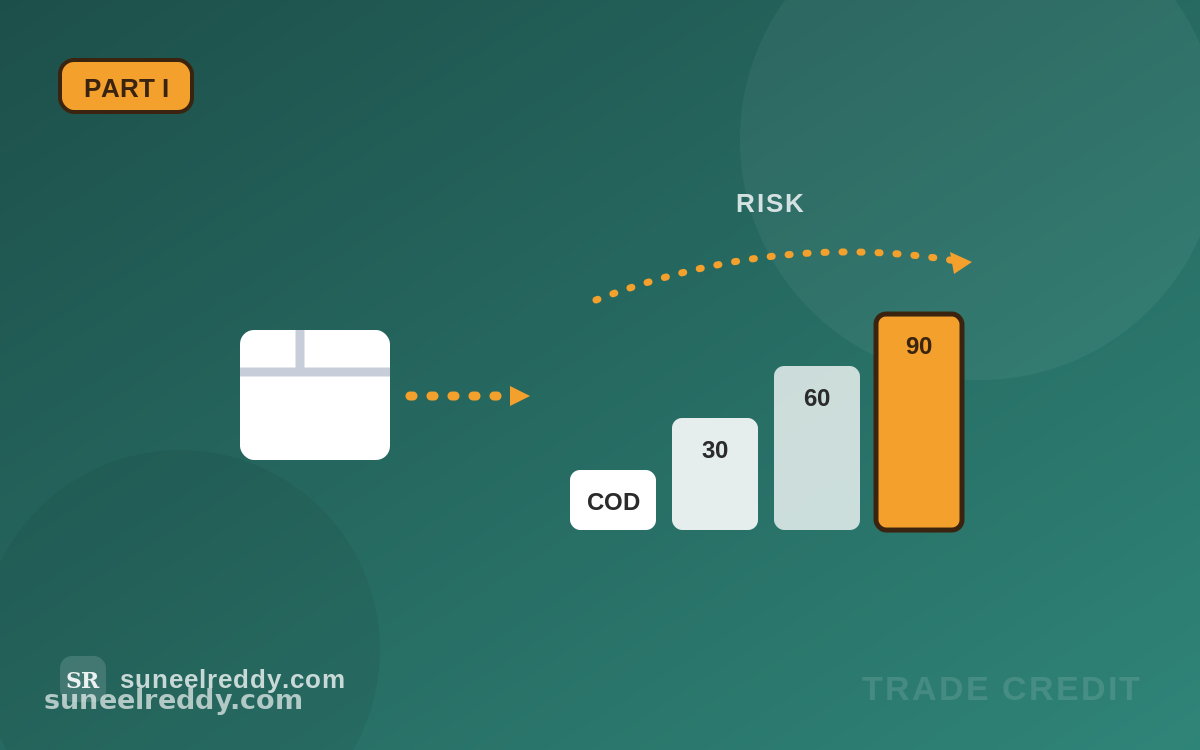
So terms should be earned, not defaulted into. The standard ladder:
| Term | Meaning | When it's the right answer |
|---|---|---|
| Advance / PIA | Payment before dispatch | New account, poor bureau, export to high-risk geography, custom goods |
| COD / CIA | Payment on delivery | Unknown counterparty, small-ticket, cash-trade sectors |
| Net 15–30 | Standard open account | Verified buyer, clean references, moderate exposure |
| 2/10 Net 30 | 2% discount if paid in 10 days | When you want cash faster and can price the discount |
| Net 45–60 | Extended open account | Strategic accounts, strong financials, long track record |
| Net 90+ | Long-dated credit | Only against security: LC, credit insurance, or anchor-grade buyer |
Note the economics of 2/10 Net 30: giving up 2% to be paid 20 days earlier is an annualised cost of roughly 2/98 × 365/20 ≈ 37%. That is expensive money. It is worth paying only if you are cash-constrained or if the discount measurably reduces default risk by shrinking the exposure window. Most firms offer it reflexively without ever computing that number.
The credit application: the document that does the work
Before terms come facts. A serious B2B credit application collects, at minimum: legal entity name and constitution, PAN and GSTIN, registered and shipping addresses, years in business, banking details, three trade references, the credit limit requested, and — the clause most firms forget — a personal guarantee or director's undertaking for closely held buyers, plus explicit acceptance of interest on overdue amounts and jurisdiction for disputes.
Two practical notes. First, the trade references are only useful if you actually call them and ask specific questions: highest credit extended, current balance, average days beyond terms, any disputes. “They're fine” is not data. Second, in India the GSTIN is your best free verification tool — filing regularity and turnover pattern tell you more about a buyer's health than their audited balance sheet from eighteen months ago.
Scoring the buyer: a workable framework
You do not need a machine-learning model to run a disciplined trade-credit book. You need a consistent scorecard applied to every account. A practical weighting:
- Financial capacity (30%). Turnover scale, leverage, current ratio, profitability trend. For MSME buyers, GST turnover trend often beats the P&L for timeliness.
- Payment behaviour (30%). Your own ledger history first — it is the single most predictive variable you own — then bureau data (Commercial CIBIL / CMR, CRIF), then trade references.
- Public record and legal (15%). MCA filings and charges, litigation, cheque-bounce history, GST cancellations, IBC proceedings.
- Relationship and strategic value (15%). Order frequency, margin contribution, tenure, growth trajectory.
- Sector and concentration (10%). Buyer's industry cycle, and your own exposure concentration to that buyer or sector.
Map the composite to a tier — A through E — and let the tier, not the salesperson, determine the default terms. The discipline is that exceptions must be logged, approved at a defined level, and time-limited. A credit policy with unlimited discretionary override is a suggestion, not a policy.
Setting the limit: four methods, one sanity check
Limits are where most trade-credit books quietly go wrong — set once at onboarding, never revisited, and anchored to a round number someone liked. Four defensible methods:
- Requirement-based. Expected monthly purchase volume × terms in months × a safety factor. A buyer purchasing ₹20 lakh a month on Net 45 needs roughly ₹30 lakh of limit; anything more is unused risk capacity.
- Capacity-based. A ceiling as a percentage of the buyer's net worth or turnover — commonly 5–10% of tangible net worth for unsecured trade credit. This is the check that stops you becoming a buyer's largest creditor by accident.
- Bureau/insurer-led. Credit insurers and agencies (Allianz Trade, Coface, ECGC, D&B) publish recommended limits. If you carry credit insurance, the insurer's limit is your effective limit — exceed it and the excess is uninsured.
- Portfolio-based. No single buyer above X% of total receivables. This is a concentration control, not a credit assessment, and it is the one that saves you when a large buyer fails.
The sanity check that ties them together: take the lowest of the four, not the highest. And express the limit as a total exposure ceiling — open invoices plus undelivered orders plus accepted-but-unshipped — not merely as outstanding invoices, which is how firms discover they had three times the exposure they thought.
Securing the exposure
Where the tier is weak but the business is wanted, the answer is rarely “decline” — it is “restructure the risk”:
- Letters of credit substitute the buyer's bank for the buyer. Cost sits with the buyer; your risk becomes the issuing bank's country and rating.
- Trade credit insurance covers non-payment for a premium, typically with 80–90% indemnity and a policy-set limit per buyer. It also outsources part of your monitoring — insurers withdraw cover before defaults, which is a free early-warning signal if you watch for it.
- Bank guarantees, security deposits, post-dated instruments work for mid-market domestic accounts.
- Receivables finance — factoring, or TReDS where the buyer is a large corporate — converts the receivable to cash and, in non-recourse structures, moves the credit risk off your book entirely. For an MSME supplier to a blue-chip anchor, this is usually the cheapest risk transfer available.
- Retention of title clauses in your contract keep legal ownership until payment. Enforceability varies, but their presence changes negotiations in insolvency.
Where Part I ends
The grant decision sets your maximum possible loss and the shape of your cash flow. Everything downstream — the monitoring in Part II, the collections in Part III — is a consequence of decisions made in this stage. Firms with disciplined onboarding spend far less on collections, not because they chase harder, but because they granted better.
One closing principle worth writing into the policy document itself: a sale is not revenue until it is cash. Until then it is a loan you chose to make, to a borrower you chose not to charge, and the only question that matters is whether you would have made that loan knowingly.
Continue to [Part II — Monitoring the Book](#/post/b2b-credit-part2-monitoring).
References
Allianz Trade — B2B credit control policies and customer credit management techniques; trade credit insurance mechanics. CreditPulse — trade credit management and B2B credit policy guides. Standard trade-credit practice on 2/10 Net 30 opportunity cost. TReDS/RXIL, M1xchange, Invoicemart — receivables discounting. ECGC, Coface, Dun & Bradstreet — buyer limits and cover.