
The Global Economy Is Growing at 3.1%. Most Countries Are Not.
When the IMF released its October outlook in Bangkok this week, the headline looked reassuring: world growth of 3.1% in 2026, edging up to 3.4% in 2027, a small upgrade on the July forecast. Global headline inflation is projected at 4.7% this year, easing to 4.1% next year. Read quickly, it says the world economy is bending under a war and an oil shock but not breaking.
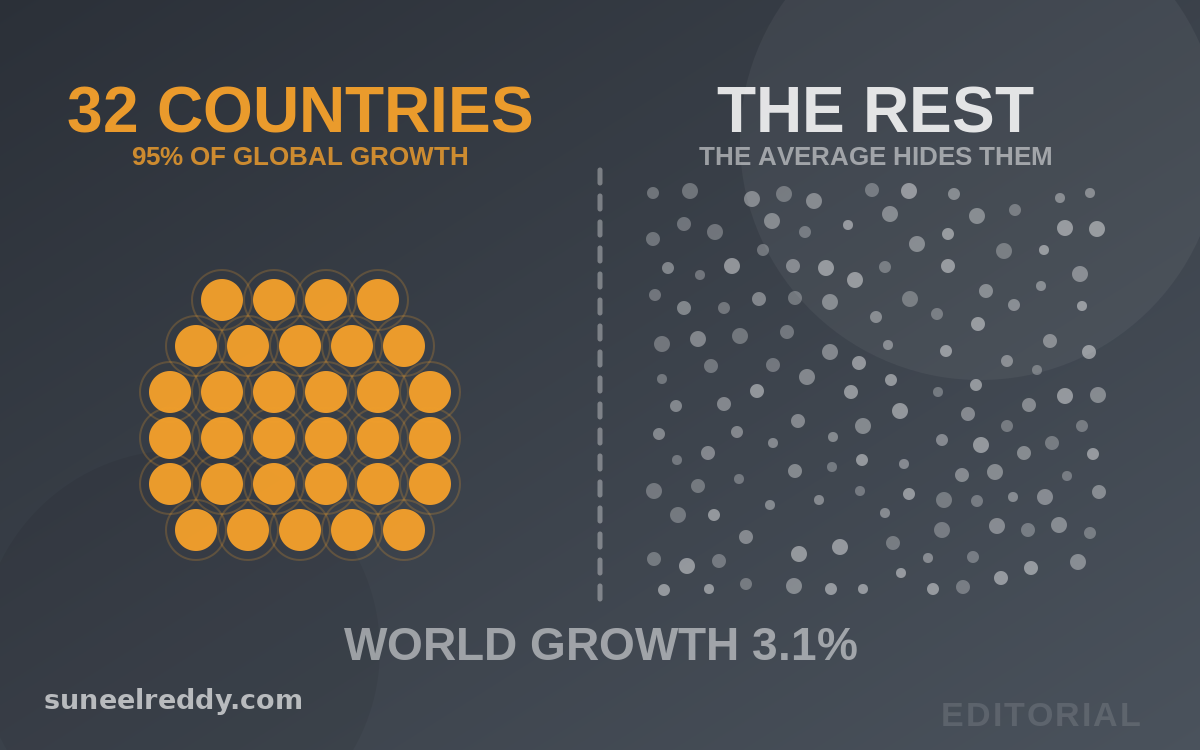
The number I could not stop looking at was buried further down. By the Fund's accounting, just 32 countries now generate 95% of global growth, down from 54 as of April. The United States and China alone account for more than three-quarters of net demand for AI-related chips and equipment imports. The IMF's own research director described the outlook as highly uneven.
My reading: a global average has stopped telling us anything useful. When growth is that concentrated, “3.1%” describes a world almost nobody lives in. A handful of AI-exposed economies are pulling the mean up while emerging and developing economies slow, to a projected 3.7% this year from 4.5% in 2025. The Middle East and Central Asia are expected to contract outright. Averages hide exactly the places where credit stress accumulates.
The baseline is also a bet. The forecast assumes Hormuz shipments resume by early 2027 and that AI demand growth moderates rather than reverses. Oil is assumed to average roughly $96 a barrel this year. The Fund itself lists the risks as tilted to the downside: a longer war, an AI-related market correction, rising bond yields, trade tensions and shrinking fiscal space. Fair-minded people can argue the other side, that resilient consumers and flexible supply chains have repeatedly beaten pessimists this decade. They may be right. But a forecast that needs two things to go well at once is not a forecast I would build a risk model around.
Four outside forces could break that baseline, and they feed each other.
War and energy. The Strait of Hormuz is the single biggest swing factor. Maritime monitoring cited this week showed only a trickle of transits against a pre-crisis norm of around 85 a day, with scores of vessels holding position, and there were fresh reports of ships struck in the Gulf and escalation around the Red Sea. Quotes for Brent have ranged from the high $80s to above $100 depending on the day and the source, which tells you how jumpy the market is. The IMF's roughly $96 average is a calm-weather assumption for a stormy market. Oil is not just a price; it is a tax on every importing country, and the poorest importers pay it first.
Currency and capital flows. A war premium in oil, a firm dollar and long US Treasury yields near 5.2% together pull capital out of emerging markets. India shows it: foreign investors have been net sellers of Indian equities in recent months, on one report to the tune of about 3.6 lakh crore rupees so far this year, and the rupee has been under pressure. For a country that buys most of its oil in dollars, a weaker currency makes the oil shock heavier, which raises inflation, which limits how far the central bank can ease. That loop is the transmission mechanism that turns a geopolitical event into a borrower's missed payment.
Trade policy. The IMF names renewed trade tensions among its downside risks, and the past year has shown how quickly tariffs can move. Washington cut tariffs on Indian goods to 18% from 50% in February in exchange for India reducing Russian oil purchases and lowering some barriers, a deal that was announced with few details. Deals like that can be reversed as fast as they were struck. For an exporter or a small importer, the issue is not the tariff rate itself but the inability to price a contract six months ahead.
Debt and fiscal space. Governments are borrowing at higher rates just as they need money for energy subsidies, defense and AI-related infrastructure. The IMF flagged that, for India, stabilizing debt at 2025 levels would require more consolidation than currently planned. When sovereigns have less room, banks and small businesses feel it through tighter credit and slower payments.
None of these forces is new alone. What worries me is the correlation. An oil spike strengthens the dollar, a stronger dollar hurts importers' currencies, weaker currencies raise inflation, and inflation keeps rates high just when growth needs relief. A stress test that shocks one variable at a time will miss all of it.
Here is where my own vantage point matters. I spent more than fifteen years building and delivering credit-risk software for lenders, and the quiet assumption inside most of those systems is that the macro environment is a single dial. Portfolios get stressed with one growth number, one rate path, one loss curve. A concentrated recovery breaks that logic. A lender with exposure to the 32 and a lender with exposure to everyone else are living through different economies, even if both read the same IMF headline.
That is why I keep returning to small businesses. An MSME in Hyderabad and a small distributor in Ohio are not on the AI supply chain. They feel the oil price, the cost of money and slower demand, and they rarely appear in aggregate data until it is late. India is a useful test: the IMF still has it as the fastest-growing major economy at 7%, yet it also faces higher inflation and a wider current account deficit this year. Strong headline growth and fragile borrower cash flow can coexist.
My conclusion is simple. In a split recovery, granular, borrower-level data beats the macro dial. Lenders, regulators and boards should stop asking “what is global growth?” and start asking “which of my borrowers sit inside the 95%, and which sit outside it?”
The next few months will show whether the baseline holds: whether Hormuz reopens on schedule, whether the dollar and long yields ease, whether trade truces survive, and whether AI spending keeps its pace. Either way, the average will keep flattering the picture.
If growth is this concentrated, how well do you actually know which side of the line your own customers, or your own business, sits on?