
The Bond Market Just Repriced Time
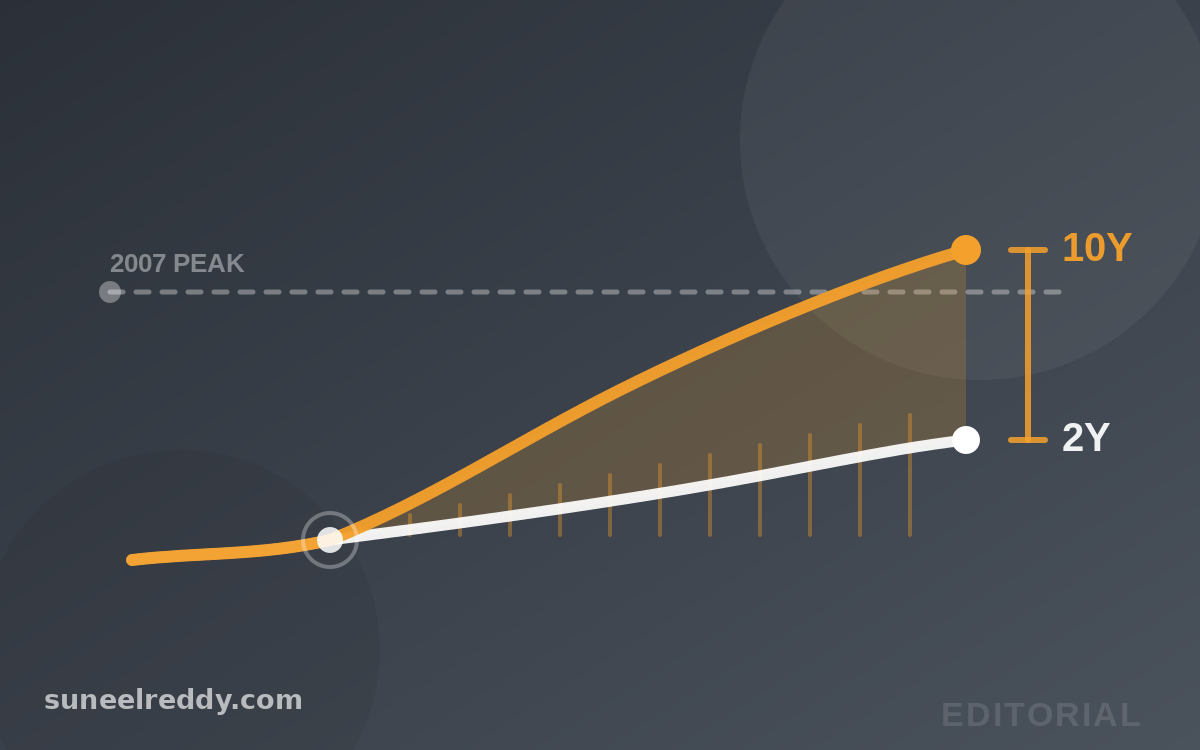
This month the 10-year US Treasury yield climbed above 5.3%, its highest level since 2002 and past the 2007 peak. It touched roughly 5.37% midweek, then slipped back below 5.25% by Friday. The retreat is the least interesting part of the story.
What interests me is what drove it. Reports on the move point to a mix: strong second-quarter growth, Brent crude near $104 a barrel, a steady stream of Treasury supply to fund federal deficits, and enormous financing needs for AI data centers and power generation. Energy was the main force behind the recent pickup in headline inflation, and Fed Vice Chair Jefferson said as much. Yet August core inflation ran at 2.4% year over year, and one analyst noted that a recent rally in Treasuries had little to do with US data at all, but rather with French fiscal worries and a global bond selloff.
My reading: this is not a Fed story, it is a term-premium story. The market is no longer paying only for where short rates go. It is demanding more compensation for lending to governments and corporations for a long time, because the supply of long-dated paper is large and the competition for capital is intense. The Fed can influence the front of the curve. It has much less say over what the world charges to hold ten years of risk.
The second headline came from India. On October 7, the Reserve Bank of India raised its repo rate by 25 basis points to 5.50%, its first hike after the 125 basis points of cuts in 2025, and moved its stance from neutral to “calibrated tightening.” The repo rate anchors what banks charge each other and everyone else, so the hike flows straight into interbank and lending rates. The committee cited August CPI inflation of 4.8%, driven by food and fuel, and projected inflation near 5.2% for the fiscal year. The rupee, meanwhile, is trading around 96.6 to the dollar, down roughly 9% over twelve months by one market tracker's count, with the central bank reportedly selling dollars to slow the slide.
I don't read that as two separate stories. Higher US yields and a firm dollar pull capital out of emerging markets; Indian assets saw outflows in September; oil priced in dollars makes the import bill heavier. A central bank facing that combination can defend the currency, defend growth, or defend price stability, and it cannot fully do all three. The RBI has chosen to lean on price stability, and I think that is defensible. India's growth is forecast at about 7.1%, which gives it room that most economies lack.
Every credit model has a risk-free rate buried in it. I spent fifteen years building and delivering credit-risk software for lenders, and one thing I learned is how quietly that input is treated. Pricing engines, scorecard cut-offs, loss discounting, RAROC hurdles: most of them assume the benchmark is a stable background number. When it moves this much, a cut-off that was profitable last year can quietly turn negative. The systems rarely say so. People notice when the portfolio does.
The pressure lands hardest on the smallest borrowers. An Indian MSME borrowing against a repo-linked rate, buying inputs priced off a weaker rupee, and paying invoices on thirty-to-ninety-day terms feels both shocks at once. A US small business sees the same squeeze through diesel, freight and refinancing. The transmission differs, the squeeze is shared, and neither borrower had any hand in causing it.
The counter-argument is fair. Yields fell back by Friday, stocks posted weekly gains, and the rupee's slide has been gradual rather than disorderly. Strong growth is a good reason for rates to rise, so this may prove a healthy repricing rather than a warning. I could be wrong about how long it lasts.
Still, my point holds either way: lenders and the people who build their systems should stop treating the cost of money and the exchange rate as constants. Stress-test pricing and approval logic against a benchmark that stays high, refresh hurdle rates more than annually, and watch the borrowers who refinance first, because they will tell you the truth before the delinquency report does.
The next tests are close: US CPI on October 14, the Fed on October 28, and the RBI's next meeting on December 2 to 4. Whatever they say, the long end has already voted.
If your model's cost of money and exchange rate both moved this month, would you notice before your borrowers did?