
The World Is Running Short of Buyers
Everyone wants to sell this month. The harder question is who is left to buy. Four stories from the past week, plus one from India, answer it in different ways, and together they say more than any one headline.
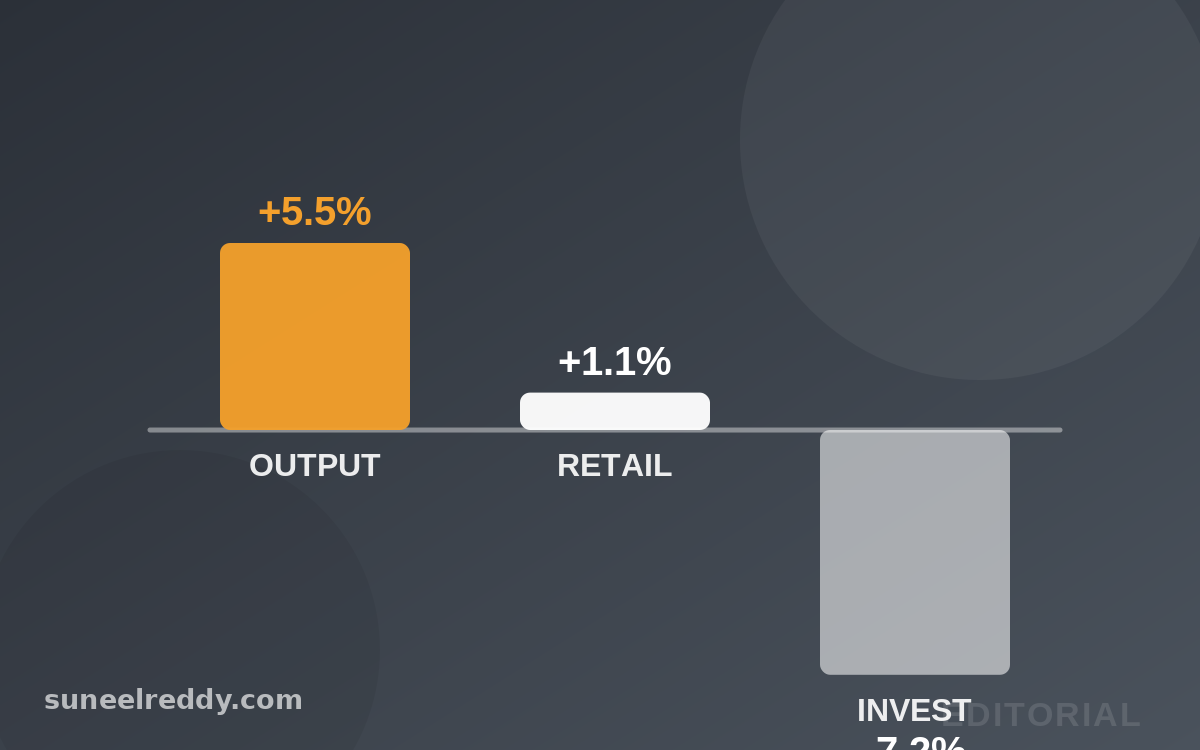
China grew 4.5% in the third quarter, up from 4.3%, and beat forecasts. Look at the mix. Industrial output rose 5.5% in September, but retail sales rose only 1.1%, and fixed-asset investment is down 7.2% for the first nine months. Exports are up more than 16% over three quarters, led by chips and tech goods tied to the AI buildout. The factories are running; the household is not.
Europe and the US show the other side of the ledger. The eurozone composite PMI slipped from 53.1 to 51.9, and France fell back into contraction, with its composite at 48.4 against 50.5 expected. In the US, reported job cuts include about 5,000 at Barclays, about 3,000 corporate roles at Kroger, and roughly 1,000 each at Netflix and eBay. On November 3, American voters decide the midterms, and tariff and fiscal policy sit in the background.
My reading: the world economy is short of buyers, not sellers. Capacity is being built faster than demand for it. A country can grow by exporting only if someone else imports, and the importers are getting cautious, with Europe already debating curbs on some Chinese goods. There is a fair counterargument: Beijing may be managing a slow, deliberate slowdown, and AI-related exports reflect real demand. But a growth model that depends on other people's appetite has a ceiling.
Now the India story, which cuts the other way. Foreign investors have net sold about ₹48,000 crore of Indian equities in October so far, and roughly ₹3.08 lakh crore this year, against ₹1.66 lakh crore in all of 2025, with the Sensex down about 2.2% on the week. Yet in the same days, Jio Platforms' ₹30,213 crore IPO, India's largest, was subscribed about 22 times. It drew more than a crore applications, reportedly a global record, and institutions bid 70 times their quota. Retail subscribed a more modest 2.7 times.
Here is what I take from that. India's buyer of last resort is increasingly Indian: domestic institutions bought over ₹3,200 crore in a single session while foreigners sold. That is a real structural strength. But note the use of proceeds: up to ₹27,500 crore goes to repay borrowings. The country's biggest offering is largely a deleveraging, and it is open only to borrowers at the very top.
I spent fifteen-plus years building and delivering credit-risk software for lenders, and when buyers get scarce, the first place it shows is not GDP. It is payment behavior. Receivables stretch, invoices get paid later, and a supplier to a company that is cutting staff or a distributor selling to a soft market feels it months before any statistic does. That is the lens I bring to a small business in Hyderabad or Ohio: ask not how fast the economy grows, but how quickly its customers are paying.
So my stance is simple. Watch days-to-pay and customer concentration, not the growth headline. A lender or a board that tracks those two numbers will see a demand slowdown earlier than one that waits for the next GDP print.
Next up: Jio's listing on October 28, the Fed this week, and the midterms on November 3.
If your customers started paying 15 days later next quarter, how long could your business carry it?