
Stabilizing the Long End: What It Would Actually Take
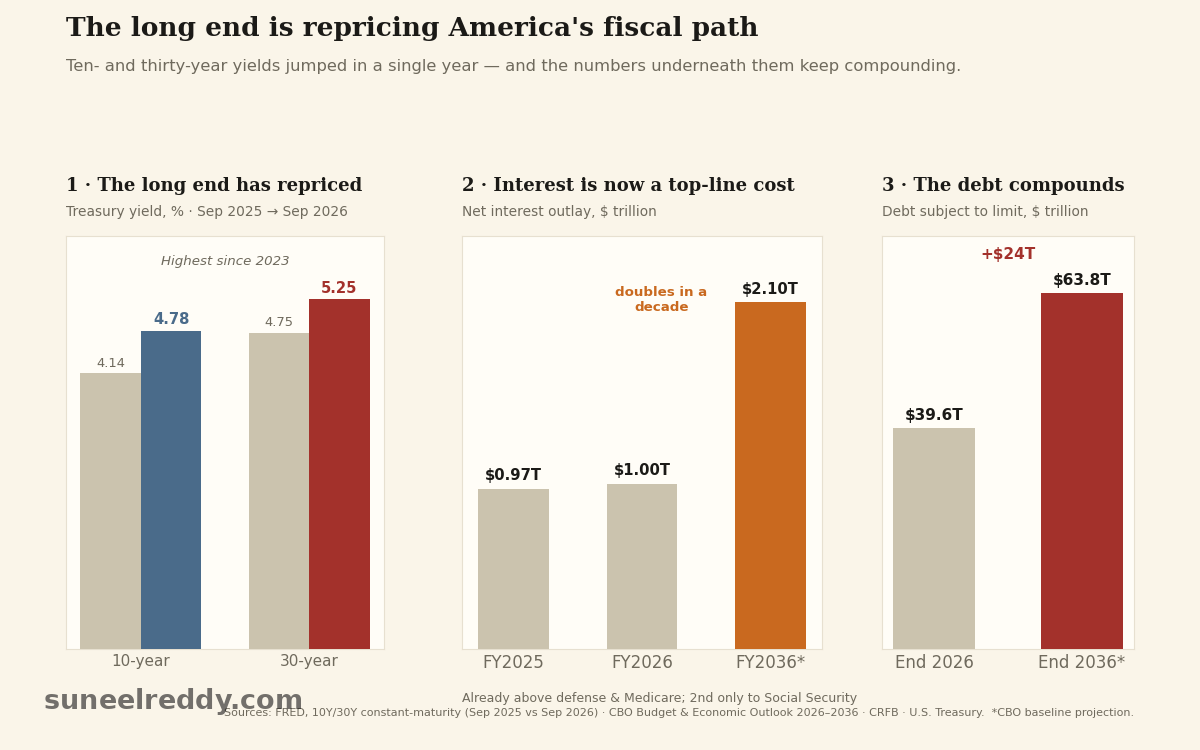
On the third of September the ten-year Treasury yielded 4.78% and the thirty-year 5.25% — the highest the long end has traded since 2023, up roughly six-tenths of a point in a single year. A bond market speaks in a language of its own, and this autumn it is saying something plainly. The question worth asking is not whether it can be quietened for a week, but what it would actually take to anchor it.
The market is pricing supply, not just prices.
The instinct is to blame inflation, and the instinct is incomplete. What has moved is the term premium — the extra yield investors demand to hold a long bond rather than roll short ones — and term premium is a verdict on supply and uncertainty, not on this month's CPI. The supply is not subtle. The CBO has marked its FY2026 deficit up to about $2.1 trillion from $1.9 trillion; net interest crossed $970 billion in FY2025, will pass $1.0 trillion this year, and is set to double to $2.1 trillion by 2036; debt subject to limit runs from $39.6 trillion at the end of this year toward $63.8 trillion in a decade. Investors are not panicking. They are repricing a rising, open-ended stream of paper — and asking to be paid for it.
The short-term tools borrow calm from the future.
There is a real toolkit for stopping a disorderly move, and most of it sits with Treasury and the Fed rather than Congress. Treasury can tilt issuance toward bills and shorter coupons to relieve the long end, and run liquidity buybacks — the expanded long-end buybacks beginning September 9 are exactly that. Regulators can exempt Treasuries from the supplementary leverage ratio, freeing banks and dealers to warehouse far more government debt without a rupee of new spending. The Fed can slow quantitative tightening and stand behind the market through its repo facility. And everyone can stop manufacturing shocks — debt-ceiling brinkmanship, shutdown theatre, public pressure on the central bank each add premium for free.
Each of these works. None of them changes the trajectory. They are painkillers that borrow calm against the future by shortening the debt's maturity or leaning on the Fed's balance sheet. Useful in a crisis; dangerous mistaken for a cure.
Only the deficit path anchors the long end.
The long yield is, at bottom, a forecast of future supply. It can only fall durably when the expected path of borrowing falls, and that requires the one thing the short-term toolkit cannot supply: a credible, legislated reduction in the primary deficit that stabilizes debt as a share of the economy. The arithmetic is unforgiving. The drivers are Social Security, Medicare, rising health costs and interest itself — so any honest plan touches entitlements and revenue together, because growth alone has never closed a gap this size. What markets reward is not a good year but a durable rule: a multi-year framework, enforceable, that survives the next election. Until the expected supply changes, the premium stays.
Will fixing America fix everyone else? Partly — and not the way people assume.
The Treasury is the world's risk-free anchor, so a share of the recent rise in gilts, Bunds and JGBs is simply the common term-premium radiating out of Washington. Lower and steady the American long end, and you relieve that shared pressure everywhere. But two things temper the hope. Every major market has its own fiscal story that American policy cannot touch — Japan's vast JGB stock and a central bank inching away from control, Britain's gilt fragility and pension plumbing, the eurozone's fragmentation where France and Italy trade on their own credibility. And the spillover can reverse: if America stabilizes by looking like the safest, highest-yielding haven again, it pulls capital toward Treasuries and widens everyone else's spreads.
So a fix in Washington is necessary and not sufficient. It removes the largest common shock while leaving each country's idiosyncratic fracture exactly where it was. The junior analyst treats a market's complaint as noise to be smoothed. The senior one treats it as information. This autumn the long end is offering information, in a currency no buyback can counterfeit: it will take the boring, structural work, or it will take the premium. There is no third option.