
Which Inflation Is the Fed Fighting?
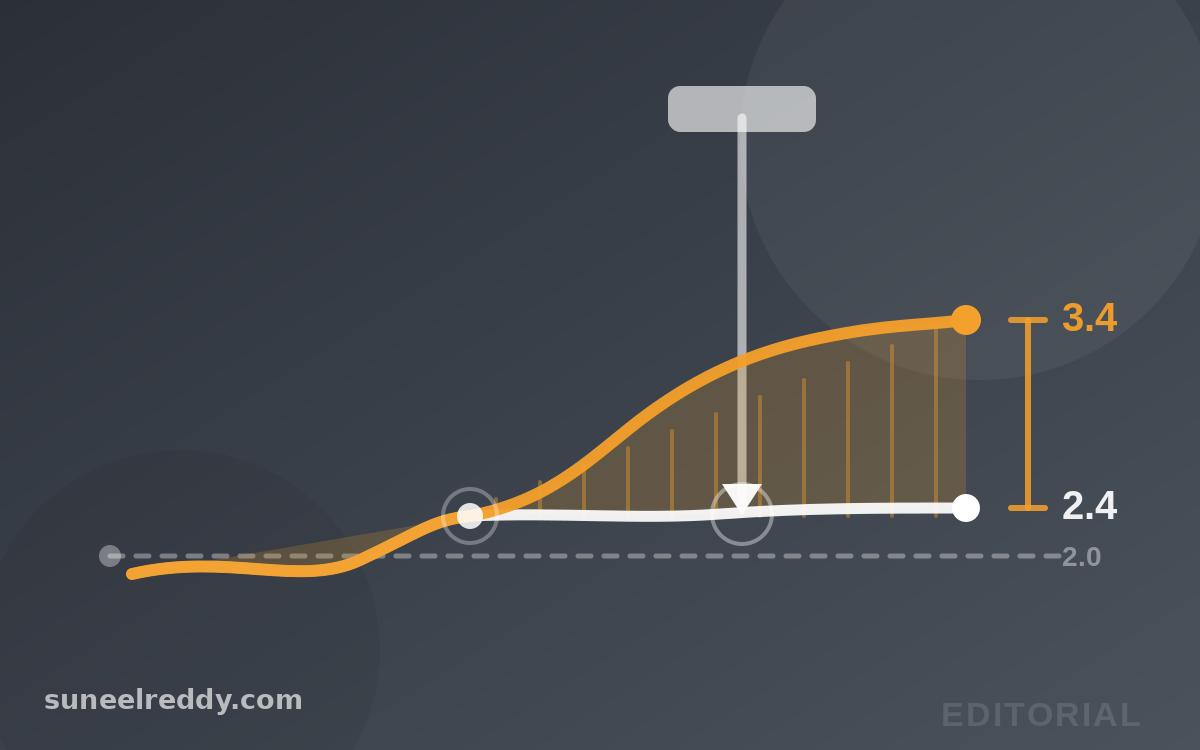
There is a hundred basis points of distance between the two inflation numbers that landed on Friday morning, and everything worth arguing about this week lives inside that gap.
August CPI came in at 0.4% for the month, putting the annual rate at 3.4%. Core — stripping out food and energy — rose 0.3% on the month and sits at 2.4% annually. Within the hour, pricing in fed funds futures put the odds of a quarter-point hike at the September 16 meeting at 90%, up from roughly 72% the day before. The target range is 3.50–3.75% today. Meanwhile Brent crossed $100 a barrel for the first time since 2022 after strikes on Middle East energy infrastructure, including Saudi facilities, and the S&P 500 finished the week down 0.8% after four straight days of declines.
So here is what is actually on the table on Wednesday: a central bank tightening against a price level that a barrel of oil moved, while its own measure of domestic price pressure sits four-tenths of a point from target.
Core at 2.4% is not an inflation problem. It is a tanker problem.
I spent fifteen years building the software lenders use to decide — the scorecards, the limit engines, the monitoring that fires when a borrower's file starts to deteriorate. That work teaches one discipline above all others: before you act on a number, you establish what generated it. A demand-driven deterioration and a margin-driven deterioration produce delinquency curves that look nearly identical for two or three quarters, and they call for opposite responses. Get the identification wrong and you cut the limit on a healthy freight company whose only problem is the price of diesel, or you extend one to a business whose customers have quietly stopped coming back. Both errors are expensive. Only one of them is visible in the data at the time you make it.
Monetary policy is facing the same identification problem this week, and the orthodox answer to it has been settled for forty years: you do not tighten into a supply shock. The shock is already contractionary — it is a tax collected at the pump and passed through the freight bill. Rates cannot produce a barrel of oil. Raising them layers a second squeeze on top of the first, and it lands hardest on precisely the borrowers the energy shock already found: working-capital-intensive, fuel-exposed, thin-margin firms that finance inventory on short-dated credit and can reprice nothing on their own side of the invoice.
And this is not really even a crude story. It is a refining story, which is worse.
Look past the Brent headline and the tighter constraint is capacity. US diesel crack spreads — the margin for turning crude into diesel — set an all-time record this month, above $106 a barrel, touching an intraday $108.02. Refined products are trading around $130 to $170 a barrel. Ukrainian strikes on Russian refineries have taken real processing capacity out of the system and pushed Moscow into diesel export bans. Industry executives expect supply to stay tight through the winter, and reporting this month suggests the crunch could hold fuel prices elevated into 2027 even if Hormuz clears and the stranded crude comes back.
That distinction matters enormously for what a policy rate can achieve. A crude spike can unwind in a month if the shooting stops. A refining shortfall cannot: the missing asset is a physical plant with a multi-year lead time. Higher rates make that plant more expensive to finance, not more likely to exist. The Fed can raise the cost of capital for the only thing that would actually fix this.
The case for hiking anyway is real, and I want to state it fairly, because it is not stupid. After a long run above target, the Fed's scarcest asset is the belief that it will not let a headline number harden into a habit. Expectations are a stock, not a flow — you cannot rebuild them retroactively once households and wage-setters have priced a 3-handle as normal. Energy spikes have leaked into core before, through freight, through packaging, through every service with a delivery van attached. On that reading, hiking into an oil shock is exactly the costly signal that proves the commitment, and the modest real economy cost is the premium on the insurance.
I think that case is honest and still wrong this month, for one reason: the two errors are not symmetric. If the Fed hikes and this turns out to be a pure supply shock, it manufactures a downturn it did not need and discovers the mistake in delinquency data two quarters later, when the borrowers are already gone. If it holds and expectations do start to drift, it will see that in breakevens and survey data early, and it has every tool required to catch up — including a faster path later. One error is reversible. The other writes off balance sheets. Credibility bought by tightening into a supply shock is credibility paid for by someone else's cash flow — and there is a cheaper instrument available, which is saying plainly what the committee is and is not responding to.
The bill is already arriving elsewhere. India imports something close to 88% of its crude. The rupee has pushed past ₹95 to the dollar, and each $10 on Brent widens the current account deficit by roughly 0.4 to 0.5 points of GDP. The RBI, facing far heavier passthrough than the United States does, has held its repo rate at 5.25% with a neutral stance while raising its FY27 inflation forecast to 5.1% and trimming growth to 6.6% — which is to say it has looked at this shock and read it as supply. A US hike strengthens the dollar into that. For the MSME borrower I now build credit ratings for, three separate things move against them at once — input costs, the currency they import in, and the price of the working capital that bridges the two — from a shock they had no part in creating and no instrument to hedge.
Wednesday will tell us which inflation the Fed thinks it is fighting. The number itself is nearly priced; the information is in the language. Watch whether the statement separates headline from core at all, or whether it reaches for “broad price pressures” and leaves the distinction for the press conference to fudge. A committee that names the supply shock and hikes anyway is making a defensible choice with its eyes open. A committee that declines to name it is telling you it has not done the identification work at all.
If the shock is in the barrel and the bottleneck is in the refinery, what exactly does a higher policy rate reach?